Sudah Rutin Olahraga, Tapi Badan Masih Pegal dan Recovery Terasa Lama? Ini yang Mungkin Tubuhmu Butuhkan
You're already disciplined. Training is scheduled, nutrition is managed, and rest is prioritized. But there's one thing that keeps getting in the way: soreness that never fully goes away, muscles that feel stiff the next day, or recovery after an intense session that takes far longer than it should.
Many people assume this is simply part of exercising. In reality, slow recovery and recurring muscle tension can be a sign that the body needs more than just rest — it needs support that works from within, not only from the outside.
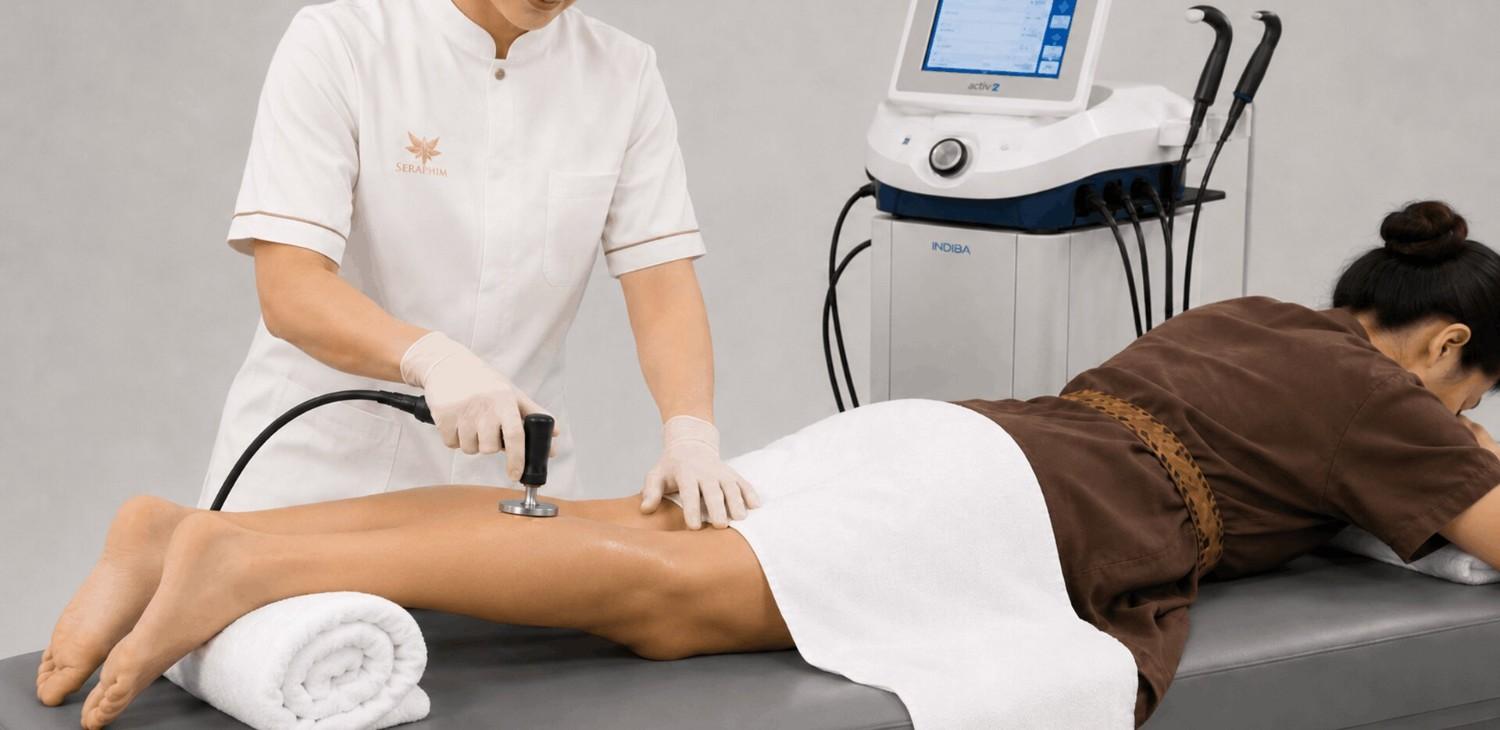
At Seraphim Medical Center, one of the technologies used to address this need is INDIBA — a radiofrequency-based therapy operating at 448 kHz, long trusted in professional sports and medical rehabilitation, now available with a personalized approach under the care of dr. Nahum, Dipl. CIBTAC, Sp.KO, Sports Medicine Specialist.
Why Does Recovery Feel So Slow, Even After Resting?
This is a question that often comes up among active individuals: why do muscles still feel heavy even after resting?
The answer lies at a level that isn't visible to the eye. Every intense training session causes small tears in muscle fibers — this is actually normal, and is in fact how the body grows stronger. The issue is that the repair process depends heavily on smooth blood circulation, adequate nutrient supply to the tissue, and overall conditions that support regeneration.
When one of these factors isn't working optimally — due to poor circulation, repeated tissue inflammation, or a body that's continuously pushed without enough rest — the recovery process slows down. The body keeps working, but not at full capacity.
dr. Nahum, Dipl. CIBTAC, Sp.KO explains that in the context of sports medicine, recovery isn't simply a matter of waiting. "Effective recovery is active recovery — one that helps the body complete its biological processes faster and more thoroughly. INDIBA is here to clinically support that process," says dr. Nahum.
What Is INDIBA and How Does It Work?
INDIBA is a non-invasive physical therapy that uses radiofrequency energy technology at 448 kHz, known as INDIBA Activ Therapy. This frequency isn't chosen at random; at the 448 kHz level, the energy has been shown to penetrate deeper tissue layers without causing excessive heat on the skin's surface — making it safe, comfortable, and effective at the same time. INDIBA is one of the most widely researched TECAR (Transfer of Energy Capacitive and Resistive) technologies available.
Think of the muscles and tissues inside your body like an engine that needs to be warmed up the right way to perform optimally. This is exactly what INDIBA does: its energy reaches deeper tissue layers, warming them from within in a controlled way, improving blood flow, and reactivating the body's natural repair processes — processes your body already has, but which need the right stimulus to work faster.
The result? More relaxed muscles, reduced inflammation, and a recovery process that no longer takes days to unfold.
"INDIBA doesn't just work on the surface. Its energy reaches deeper tissue layers — muscles, tendons, joints, even bone — and stimulates biological processes the body already has, but which need the right stimulation to function optimally," explains dr. Nahum, Dipl. CIBTAC, Sp.KO.
Benefits of INDIBA for Sports Recovery
As a technology widely used in professional sports environments across more than 70 countries, INDIBA has a strong track record of supporting athlete performance and recovery. At Seraphim Medical Center, this technology is integrated into a comprehensive sports medicine approach led by dr. Nahum, Dipl. CIBTAC, Sp.KO.
Muscle recovery after intense training. By improving circulation and increasing activity in muscle tissue, INDIBA helps the body complete its repair process faster — meaning you can return to training feeling fresher in a shorter amount of time.
Relieving muscle tension and stiffness. The warmth generated by INDIBA from within helps tense muscles relax — reducing the stiffness that is often the main complaint after a heavy training session or competition.
Supporting injury rehabilitation. For those recovering from sports injuries — ranging from muscle strains and tendon issues to joint pain — INDIBA can be part of a recovery protocol that helps the affected tissue heal more optimally.
Preparing the body before training or competition. INDIBA isn't only used after exercise. As part of preparation before a heavy session or competition, this therapy helps put muscle tissue in a more ready and responsive state.
dr. Nahum, Dipl. CIBTAC, Sp.KO emphasizes that these benefits cannot be generalized for everyone. "Every active individual has different tissue conditions, different recovery needs, and different goals. Our approach always begins with an evaluation of the patient's actual condition," dr. Nahum states.
INDIBA and Sports Medicine: A Different Approach
What sets the use of INDIBA at Seraphim Medical Center apart from regular physical therapy is its clinical context. This technology is used within a sports medicine framework led by dr. Nahum, Dipl. CIBTAC, Sp.KO — a specialist who understands how the body responds under physical stress during training or sport, how injuries occur, and how the right intervention can accelerate recovery without compromising long-term performance.
This isn't just a massage or conventional physiotherapy. It's a technology-based medical approach designed for anyone who takes their physical condition seriously — whether professional athletes, recreational sports enthusiasts, or those living an active lifestyle who want their body to function at its best.
"In sports medicine, we don't just look at the injury or complaint. We look at a person's overall movement patterns, training load, and recovery capacity. INDIBA is one of the tools that helps us intervene more precisely," explains dr. Nahum, Dipl. CIBTAC, Sp.KO.
Who Is INDIBA Therapy Suitable For at Seraphim Medical Center?
INDIBA is relevant for a range of physically active individuals, including:
Those who exercise regularly — gym training, running, cycling, swimming, or team sports — and feel that their recovery isn't as fast as expected despite adequate rest.
Those currently going through sports injury rehabilitation who want to support their healing with a proven medical technology approach.
Those looking to improve performance by ensuring their muscle and joint condition remains optimal before and after training.
Those experiencing recurring muscle or joint pain that begins to disrupt training consistency and everyday comfort of movement.
However, as dr. Nahum, Dipl. CIBTAC, Sp.KO always emphasizes — the first step isn't choosing a therapy, but understanding the body's condition first. "A good therapeutic decision always starts with a good diagnosis. Consultation isn't a formality — it's the foundation of the entire treatment process," says dr. Nahum.
Start with a Consultation with a Specialist
If you feel that your training and recovery cycle hasn't been working the way it should, or you have a recurring physical complaint without clear resolution — now is the right time to speak directly with dr. Nahum, Dipl. CIBTAC, Sp.KO at Seraphim Medical Center.
Not to be immediately scheduled for a specific device, but to have your body's condition genuinely understood — and from there, to determine the most appropriate approach, including whether INDIBA is part of the solution.
About Seraphim Medical Center
As a business unit under Bethsaida Healthcare, Seraphim Medical Center is located in Paramount Gading Serpong and offers modern, state-of-the-art facilities including INDIBA, Venus Versa, Endymed, Cryo Chamber Therapy, Transcranial Pulse Stimulation (TPS), Hyperbaric Oxygen Therapy, PicoWay Laser, Fotona Laser, a range of IV drip therapies, and various other services.
Seraphim Medical Center adopts a functional medicine approach, focusing on identifying and addressing the root causes of health issues rather than merely managing symptoms. Its medical services are designed with a personalized approach to help the body function optimally — whether for maintaining overall health, supporting recovery, or improving quality of life.
Seraphim Medical Center has three integrated centers of excellence: the Wellness Center, the Beauty & Aesthetic Center, and the Sports & Rehabilitation Center, working collaboratively to support a modern, holistic healthy lifestyle.
Related News
view all articles
Endymed RF: Teknologi Radiofrekuensi untuk Kontur Tubuh Ideal
Tubuh Lebih Segar dan Bebas Kembung dengan Lymphatic Massage
Apa Itu Fotona Laser dan Bagaimana Cara Kerjanya?